
DeepSeek
All DeepSeek models are reasoning models and have thinking enabled by default. Usethinking to enable or disable thinking and configure its intensity:
DeepSeek enables thinking by default. The default
reasoning_effort is high; the supported effort levels are low, high, and max.reasoning_content from the response message. It is a sibling of content:
reasoning_content back on subsequent turns, and whether it becomes part of the context, depends on whether the request includes tools:
- With
tools: Sendreasoning_contentfrom all previous turns. It becomes part of the context. - Without
tools: There is no need to sendreasoning_content. Even if you include it, the API ignores it.
Reasoning models generally do not support system prompts or parameters such as
temperature, presence_penalty, and frequency_penalty. Omit these from your requests.OpenAI
OpenAI’s latest 5- and 6-series models are reasoning models with thinking enabled by default. Setthinking.reasoning_effort to choose a reasoning effort level:
none: Disables thinking, starting with GPT-5.1. GPT-6 Astra does not support this value. Use it for latency-sensitive tasks that need neither reasoning nor chained tool calls, such as speech recognition, quick lookups, and classification.low: Balances speed and cost for tool use, planning, search, and multi-step decisions. Examples include data analysis, document drafting, coding to a plan, and customer support chats.medium: Use when quality and reliability require planning, complex reasoning, or judgment. Examples include agentic coding, research, working with spreadsheets and slides, and delegating long-running tasks.high: Use for rigorous reasoning, complex debugging, detailed planning, or tasks with high quality requirements, such as agentic coding, long-term research planning, and knowledge work. Compare medium and high based on task complexity.xhigh: Use for in-depth research, asynchronous workflows, and long-running tasks such as security checks, code reviews, enterprise productivity tasks, and complex coding workflows.max: Reserve the most intensive reasoning for the most complex tasks. If you use xhigh today, evaluate whether max improves results.
medium, except on GPT-5.1, which defaults to none (no reasoning).
<think> and </think> tags within the answer, making it hard to extract from a stream. GeekAI exposes reasoning text for all reasoning models in the DeepSeek-compatible reasoning_content field. The field is empty if there is no reasoning text.
For more on
thinking, see the API reference.Claude
The latest Claude 4- and 5-series models support thinking. Claude models with this capability use hybrid reasoning. Setthinking.type to choose the mode:
enabled: Enables reasoning on Claude 4.5 and earlier. Claude 4.6 and later return a400error for this value.disabled: Disables reasoning. Claude Fable models do not support this value.adaptive: Lets the model decide when and how deeply to think. Claude 4.6 and later support this value and use it by default.
thinking.type is enabled, use thinking.budget_tokens to set the thinking token budget:
max_tokens, budget_tokens must not exceed max_tokens. Claude does not support temperature, top_p, or top_k when reasoning is enabled.
On Claude 4.6 and later, output_config.effort controls effort across the whole response. In adaptive thinking mode, this includes how often and how deeply Claude thinks:
Gemini
Starting with Gemini 2.5, all models reason by default. For a faster reply, setthinking.budget_tokens to 0 to turn off thinking (except on Gemini 2.5 Pro, which cannot disable it). Set thinking.include_thoughts to true to include reasoning text; the default, false, hides it. Increase thinking.budget_tokens to allow more tokens for deeper reasoning:
thinking.thinking_level to set reasoning effort on Gemini chat models:
minimal: Equivalent to disabling thinking. This is the default on Gemini 3.5 Flash, 3.1 Flash-Lite, and Gemini 3.1 Flash Image. Gemini 3.8 Flash and Gemini 4 Argon do not support it.low: Faster reasoning for tasks that need little depth. Gemini 3.1 Flash Image does not support this level.medium: Balanced reasoning for most tasks. This is the default on Gemini 3.6 Flash, Gemini 3.8 Flash, and Gemini 4 Argon. Gemini 3.1 Flash Image does not support it.high: The highest effort. Reasoning may take longer, but goes deeper. This is the default on Gemini 3 Flash.
reasoning_content field.
For multi-turn conversations, Gemini returns encrypted reasoning context in encrypted_content (Gemini’s underlying thoughtSignature). Send it back during function calling to preserve that context.
Models whose names end in
:no-thinking already have thinking disabled and budget_tokens set to 0. You can omit thinking.Grok 4
Grok 4 is xAI’s vision reasoning model and accepts image inputs. Thinking is enabled by default and cannot currently be disabled. As with OpenAI, usereasoning_effort to control effort:
reasoning_content field.
Qwen3
All Qwen3 models combine reasoning and non-reasoning modes. Toggle thinking with the Qwen-onlyenable_thinking parameter. As with OpenAI, reasoning_effort controls reasoning effort:
GLM/MiniMax/Kimi/Seed/Hunyuan
The latest GLM, MiniMax, Kimi, Seed, and Hunyuan models reason by default. Setthinking.type to enable or disable thinking:
enabled: Enables reasoning.disabled: Disables reasoning.
thinking.reasoning_effort to control reasoning effort. This setting takes effect only on GLM 5.2 and later with reasoning enabled. The supported values are the same as OpenAI’s:
Other reasoning models
Other models with thinking support include Grok 3, Grok 4, Qwen QwQ/QvQ, ERNIE X1, and Hunyuan T1. GeekAI automatically normalizes reasoning requests and responses to the DeepSeek-compatible format. Only reasoning models support thinking mode. The model catalog lists all 40+ reasoning models on GeekAI. Some also support web-assisted or deep reasoning, including the DeepSeek web reasoning, DeepSeek deep reasoning, and Grok deep reasoning variants: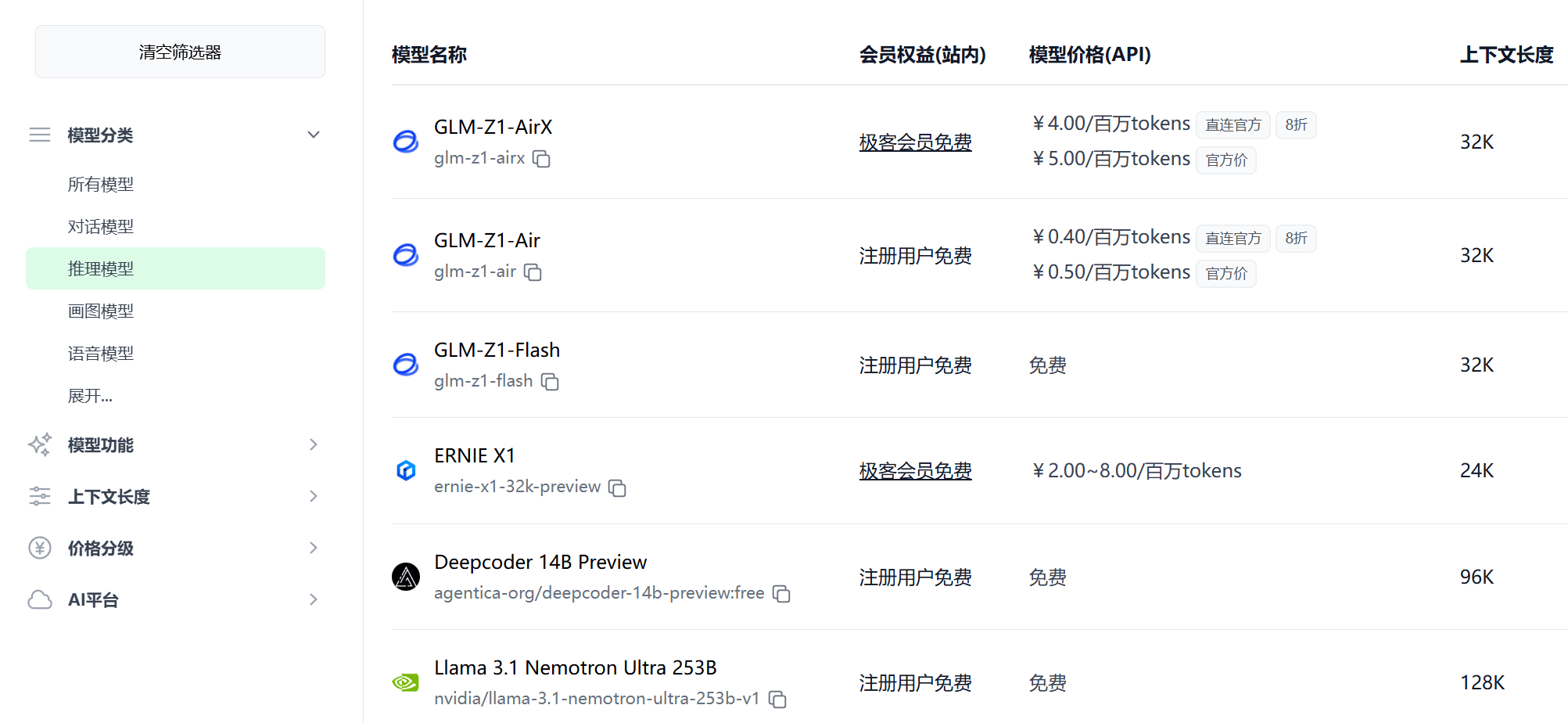 Reasoning models generally do not support system prompts or temperature settings. Omit both from API requests.